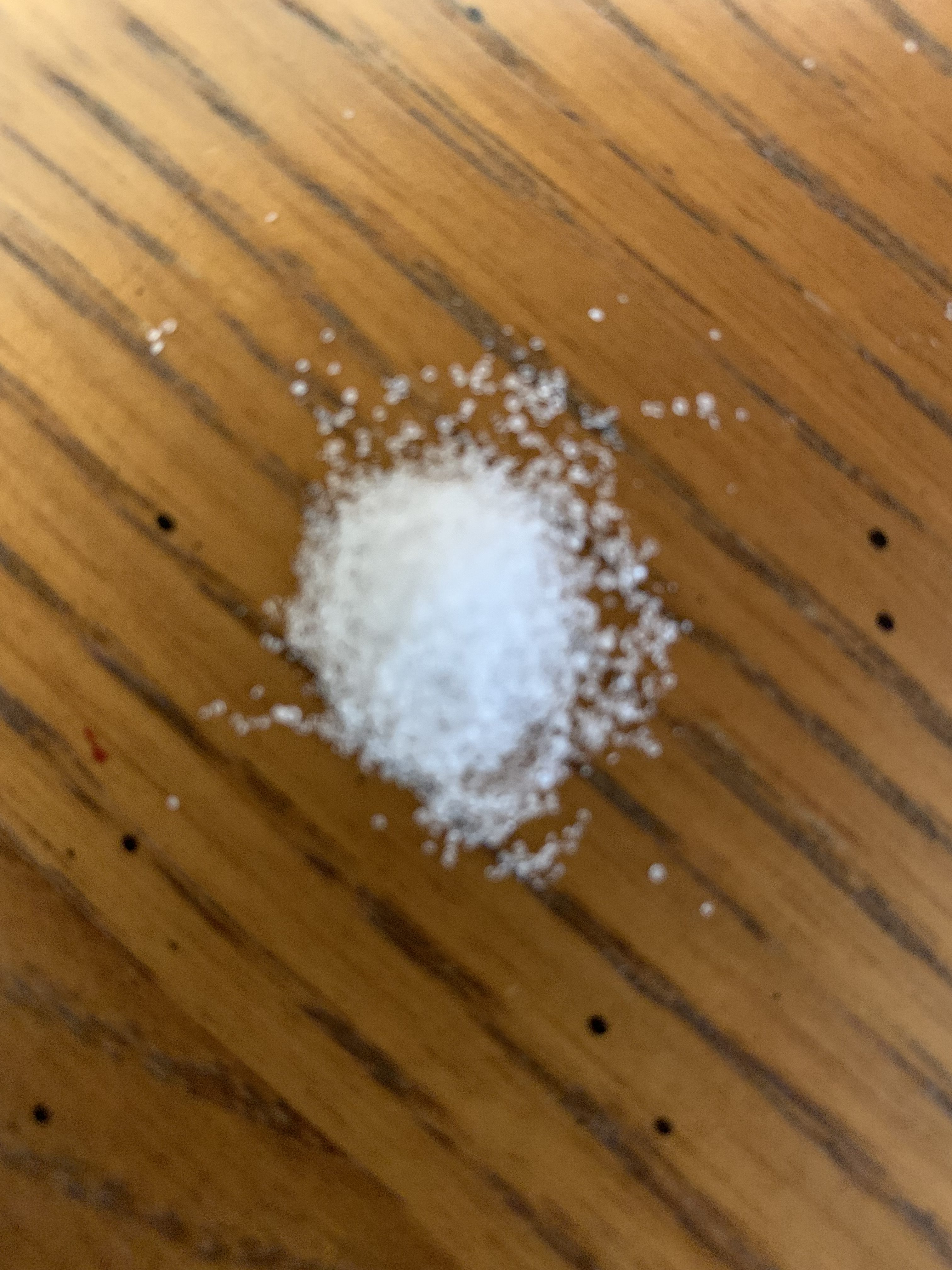
Humans need a small amount of salt daily to stay alive. But in 2025, the necessary number is much smaller than the amount most people consume. You need somewhere around 500 milligrams per day, and numerous sources of nutritional advice recommend that you keep your consumption below 1.5 grams (or about one-quarter of a teaspoon).
Using the range of 500 milligrams to 1 gram, one person needs somewhere slightly under half a sixteen-ounce pound to slightly under one pound of sodium chloride (“table salt,” or NaCl) per year.
For a modern eater, especially in a society overconsuming processed foods (with ample salt added) and red meat (unprocessed cuts of beef and pork have a decent amount of salt in them and smoked or salted meats like jerky or bacon have a lot of salt in them), getting enough sodium is as easy as eating your typical daily meals.
So that amount of salt might not sound daunting until you consider several specific medieval realities: the difficulties of preserving foods in the pre-electricity ages, the low amount of red meat in most medieval people’s diets, and the large amount of salt needed to make foods such as butter and cheese.
A. R. Bridbury’s England and the Salt Trade in the Later Middle Ages is the most useful book on salt for my purposes that I’ve discovered so far. Bridbury found that medieval food preparation used one hundredweight of salt for every ten pounds of butter or cheese. And salting seventeen lasts of herring (about 17×12,000 herring) required one hundredweight of salt.
For pickling, according to Bridbury, you need about 0.8 percent to 1.5 percent of the vegetable’s weight in salt to preserve the vegetables in brine.
Animals such as deer, cows, sheep, and horses also need to ingest salt, too, and often significantly multiples more than we do. For horses, cows, and other animals, you can add salt to the feed (e.g., oats) or feed them vegetables (turnips, radishes, beets, and other leafy plants) so that they ingest enough salt. But we did not widely figure out that livestock would eat root vegetables or grow those crops in adequate amounts until, according to some sources, the medieval period was essentially over. (In the wild, animals often rely on “salt licks,” or exposed mineral deposits; dried-up salt lake beds; or even urine puddles to get their necessary salt.)
During the period I’m using as my target range, a quarter of salt cost about 6s4d to 7s3d. As a bulk commodity, salt typically was sold and transported by the hundredweight (four quarters per one hundredweight)
Humans learned to produce mass quantities of salt in three ways: 1) boiling salt water from brine spring (favored because of the high salt yield for the volume and the ease of skimming off the salt scum and getting to the third salt (our table salt); 2) evaporating sea water in large networks of shallow lagoons (cheaper but also harder to yield pure table salt in massive quantities); and 3) mining or digging from mineral deposits in “salt mountains,” old sea or lake beds, and other sources.
A salt-weller, or salt boiler, could earn about 15p per week prior to the Black Death, and Bridbury had details from at least one court case after 1350 in which the salt-well was making about 3.5p per day or 2 shilling per week.
Without consuming adequate salt, a person risks not only normal symptoms like headaches, weakness, light-headedness, cramping, and nausea but also dangerous events like heart attacks, stokes, or heart failure.
Bottom line: humans need salt, or they are dead. So salt production or commodity trading in salt will always be profitable, especially for less wealthy traders, countries, or kingdoms. A king about to send an army on campaign would be buying salt, too, not only weapons and armor, because a lot of campaign foods required salt. But consuming too much salt also increases your risks of early death. And wealthier countries or ones without easy access to salt water tend to trade more valuable commodities or products and import their salt. As the economies developed, English producers shifted from making salt to focusing on sacks of wool and, eventually, textiles.
Note on weights: Eight stones of fourteen pounds equals one hundredweight, so one hundredweight equals 112 pounds, and twenty hundredweights equals one (long) ton of 2,240 pounds. One (long) ton of 80 quarters is a normal load for a four-wheeled wagon or long cart.




Leave a Reply